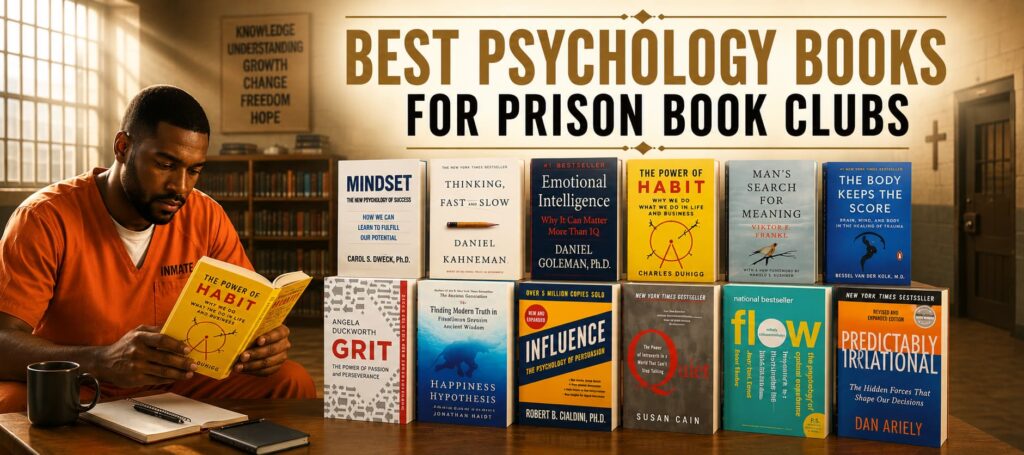
Understanding why people think, feel, and behave the way they do can lead to meaningful conversations. For incarcerated readers, psychology books can open discussions about habits, emotions, relationships, decision-making, resilience, and personal growth.
The best psychology books for Prison Book Clubs are accessible, thought-provoking, and discussion-friendly. They do not require formal training in psychology, yet they offer powerful insights into human behavior that readers can reflect on together.
Below is a curated selection of psychology books that work especially well in group reading settings.
Why Psychology Books Work Well in Prison Book Clubs
Psychology naturally invites reflection and conversation. It helps readers explore real-life behavior and the reasons behind everyday choices.
Common discussion themes include:
- Decision-making and judgment
- Habits and behavior change
- Communication and relationships
- Motivation and discipline
- Emotional awareness
- Personal growth and identity
Because these topics are universal, psychology books often help participants connect ideas to their own experiences and perspectives.
1. Mindset by Carol S. Dweck
Mindset introduces the idea of fixed vs. growth mindsets, how beliefs about ability shape learning and improvement.
Key discussion points:
- Learning from mistakes
- Handling setbacks
- Building new skills
- Persistence and effort
- Self-improvement
This is one of the most accessible psychology books for Prison Book Clubs focused on growth and education.
2. Thinking, Fast and Slow by Daniel Kahneman
This book explores how people think in two ways: fast, intuitive thinking and slower, more deliberate reasoning.
Discussion themes:
- Bias and assumptions
- Decision-making errors
- Risk and judgment
- Intuition vs. logic
It is more complex than other psychology books, but rewarding for groups willing to read slowly and discuss in sections.
3. Emotional Intelligence by Daniel Goleman
This influential book explains how emotions affect behavior, relationships, and decision-making.
Key ideas include:
- Self-awareness
- Emotional regulation
- Empathy
- Motivation
- Social skills
It works well in Prison Book Clubs because it connects directly to communication and everyday interactions.
4. The Power of Habit by Charles Duhigg
This book explains how habits form and how they can be changed through understanding cues, routines, and rewards.
Discussion topics:
- Habit triggers
- Behavior loops
- Routine building
- Breaking patterns
- Daily decision-making
Its storytelling style makes psychological concepts easy to follow and apply.
5. Man’s Search for Meaning by Viktor E. Frankl
Frankl’s memoir and psychological reflections explore meaning, suffering, and resilience.
Key themes:
- Finding purpose in hardship
- Mental resilience
- Responsibility and choice
- Hope under difficult conditions
This is one of the most powerful psychology books for reflection, but it should be used thoughtfully due to its intense subject matter.
6. The Body Keeps the Score by Bessel van der Kolk
This book explores trauma and how it affects the brain, body, and behavior.
Important discussion areas:
- Trauma and memory
- Emotional responses
- Healing and recovery
- Mind-body connection
Because of its sensitive content, facilitators should ensure it is appropriate for the group and avoid personal trauma sharing.
7. Grit by Angela Duckworth
Grit focuses on passion and perseverance as key factors in long-term success.
Discussion points:
- Persistence through challenges
- Motivation and goals
- Practice and improvement
- Overcoming failure
It is one of the more practical psychology books for discussions about discipline and achievement.
8. The Happiness Hypothesis by Jonathan Haidt
This book blends psychology, philosophy, and ancient wisdom to explore happiness and meaning.
Key ideas:
- Emotional balance
- Relationships and purpose
- Human behavior patterns
- Modern vs. traditional views of happiness
It works well for groups that enjoy deeper, reflective conversations.
9. Influence by Robert Cialdini
This book explains the psychology behind persuasion and why people say yes.
Core topics:
- Social influence
- Authority and trust
- Reciprocity
- Decision-making patterns
It helps readers understand how influence works in everyday life and how to recognize it.
10. Quiet by Susan Cain
Quiet explores introversion and how personality shapes communication and creativity.
Discussion themes:
- Introversion vs. extroversion
- Social expectations
- Leadership styles
- Communication differences
It encourages reflection on personality and how people interact in different ways.
11. Flow by Mihaly Csikszentmihalyi
This book describes “flow”—a state of deep focus and engagement in meaningful activities.
Key ideas:
- Focus and attention
- Skill development
- Motivation
- Satisfaction through activity
It connects well to creative or skill-building activities like reading, writing, or learning.
12. Predictably Irrational by Dan Ariely
This book explores how people often make irrational but predictable decisions.
Discussion topics:
- Behavioral biases
- Money and decision-making
- Social comparisons
- Everyday irrational choices
It uses experiments and examples that make psychology easy to understand and discuss.
What Makes a Good Psychology Book for Prison Book Clubs?
Not all psychology books are suitable for group reading. The best choices usually:
- Use clear, accessible language
- Encourage discussion and reflection
- Avoid overly technical explanations
- Handle sensitive topics responsibly
- Offer practical or relatable insights
Books involving trauma, addiction, or mental health should be selected carefully and discussed with sensitivity.
Match Psychology Books to Reading Levels
Some psychology books are highly academic, while others are written for general audiences.
More accessible choices may include:
- Mindset
- Grit
- Quiet
- The Power of Habit
More advanced psychology books:
- Thinking, Fast and Slow
- Flow
- The Happiness Hypothesis
Matching the book to the group ensures better understanding and participation.
Using Psychology Books for Discussion
Psychology books work best when they spark conversation rather than passive reading.
Helpful discussion questions:
- What idea stood out to you most?
- Do you agree or disagree with the author?
- How does this apply to real life?
- What examples support or challenge the idea?
- What questions does the book leave unanswered?
These questions encourage critical thinking and shared reflection.
Psychology Books and Personal Growth
Psychology books can support self-reflection and personal development by helping readers think differently about behavior, habits, and emotions.
However, they are educational tools, not substitutes for professional mental health support. Their value lies in learning and reflection, not diagnosis or treatment.
Check Facility Rules Before Sending Books
Before ordering psychology books for incarcerated readers, verify the correctional facility’s current policies.
Rules may cover:
- Approved sellers
- Paperback or hardcover formats
- Content restrictions
- Quantity limits
- Shipping procedures
- Recipient information
A book’s educational value does not guarantee acceptance by every institution. Always check the specific facility’s current requirements before purchasing or shipping books.
How Prison Book Clubs Supports Meaningful Learning
At Prison Book Clubs, we believe books can create opportunities to understand ideas, question assumptions, and learn from different perspectives.
Psychology books can support that mission by introducing participants to topics involving behavior, emotions, habits, relationships, motivation, and decision-making.
Through respectful discussion, readers can compare interpretations and strengthen critical thinking while learning more about psychology and human behavior.
Frequently Asked Questions
What are the best psychology books for Prison Book Clubs?
Strong choices include Mindset, The Power of Habit, Grit, Emotional Intelligence, Quiet, and Man’s Search for Meaning. The right choice depends on the group’s interests and reading level.
Are psychology books good for incarcerated readers?
Psychology books can provide educational insights into human behavior, decision-making, emotions, habits, communication, and relationships while creating meaningful discussion opportunities.
What psychology books are easiest to read?
Mindset, Grit, Quiet, and The Power of Habit are generally more accessible than highly academic psychology texts.
Can psychology books help with personal growth?
They can introduce ideas that encourage reflection on habits, communication, motivation, and decision-making. They should be treated as educational resources rather than personalized mental health advice.
Can families send psychology books to prison?
Many facilities accept books that meet institutional requirements, but policies vary. Check current rules regarding approved sellers, book formats, content, and shipping before ordering.
Contact Us
If you have any other questions or queries related to our services, feel free to contact us at:
- Email: info@prisonbookclubs.com
- Website: prisonbookclubs.com
We’re here to serve you.
Final Thoughts
The best psychology books for Prison Book Clubs offer insight into human behavior while encouraging meaningful discussion. Titles like Mindset, The Power of Habit, Emotional Intelligence, Grit, and Thinking, Fast and Slow help readers explore how people think, feel, and make decisions.
With thoughtful selection, psychology books can support education, reflection, and stronger group conversations. When matched to the right reading level and discussed respectfully, they become powerful tools for learning and personal growth.