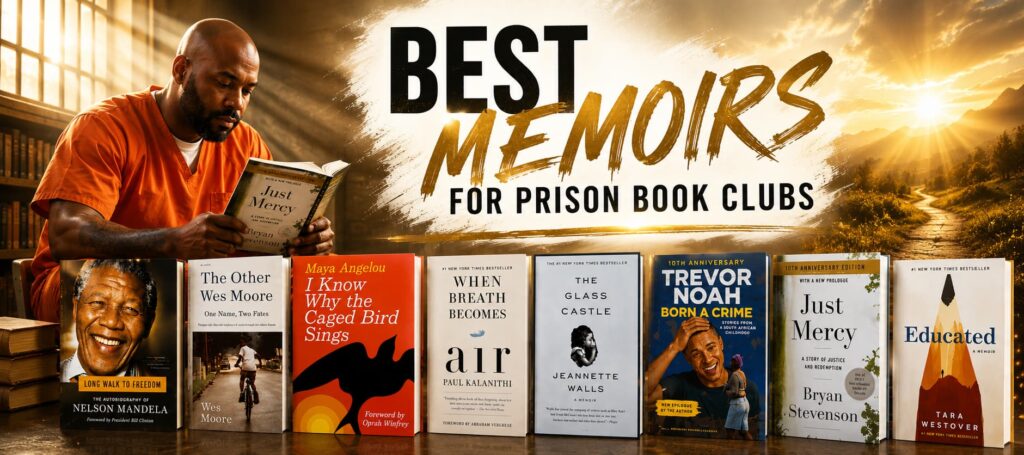
True stories can create some of the most powerful discussions in a reading group. Memoirs allow readers to experience another person’s struggles, choices, relationships, failures, and growth while considering how those experiences connect with broader questions about life.
The best memoirs for Prison Book Clubs combine engaging storytelling with themes such as resilience, identity, justice, education, family, recovery, and personal change. They can help incarcerated readers explore real experiences while building literacy and critical thinking.
Below are some of the best memoirs to consider for Prison Book Clubs, along with the themes that can make each book valuable for discussion.
Why Memoirs Work Well in Prison Book Clubs
Memoirs differ from fiction because authors are reflecting on experiences from their own lives. This makes them useful for discussing:
- Personal choices
- Identity
- Family relationships
- Resilience
- Education
- Responsibility
- Social challenges
- Transformation
The best memoirs also remind readers that one person’s experience does not represent everyone’s. That makes them excellent starting points for comparing perspectives and asking thoughtful questions.
1. The Autobiography of Malcolm X
The Autobiography of Malcolm X, told to Alex Haley, follows Malcolm X’s life through major changes in identity, education, religion, politics, and personal philosophy.
For Prison Book Clubs, the book offers rich discussion around:
- Self-education
- Transformation
- Race in America
- Identity
- Beliefs
- Personal growth
It is often included among the best memoirs and autobiographical works for readers interested in how education and experience can reshape a person’s worldview.
2. Educated by Tara Westover
Educated tells the story of Tara Westover’s unconventional childhood and her path toward formal education. The memoir explores family loyalty, independence, learning, identity, and the difficult process of questioning long-held beliefs.
It can generate conversations about:
- The meaning of education
- Family influence
- Personal independence
- Changing beliefs
- Self-discovery
Among the best memoirs about education and transformation, it offers many opportunities for reflection.
3. Just Mercy by Bryan Stevenson
Just Mercy combines memoir with stories from Bryan Stevenson’s work as an attorney representing people in the criminal justice system. The book explores justice, punishment, inequality, legal advocacy, and human dignity.
For Prison Book Clubs, discussions can focus on:
- Fairness
- Sentencing
- Second chances
- Mercy
- Legal systems
- Human dignity
Because the book relates directly to incarceration and criminal justice, it may be one of the best memoirs for groups interested in serious discussions about law and society.
4. Born a Crime by Trevor Noah
Born a Crime recounts Trevor Noah’s childhood in South Africa during and after apartheid. The memoir blends humor with serious discussions about race, poverty, family, identity, and survival. Its storytelling style makes difficult subjects approachable without removing their seriousness.
Key themes include:
- Family
- Identity
- Race
- Adaptability
- Education
- Social inequality
For readers who prefer engaging storytelling, it can be one of the best memoirs to introduce into a group program.
5. The Glass Castle by Jeannette Walls
The Glass Castle tells the story of Jeannette Walls growing up in an unstable and unconventional family. The memoir explores poverty, family loyalty, neglect, resilience, and independence.
Readers can discuss questions such as:
- What does loyalty mean?
- When should a person separate from harmful patterns?
- How does childhood influence adulthood?
- What creates resilience?
Its complex family relationships make it one of the best memoirs for thoughtful discussion.
6. When Breath Becomes Air by Paul Kalanithi
Paul Kalanithi was a neurosurgeon diagnosed with terminal cancer while still relatively young. When Breath Becomes Air reflects on mortality, purpose, work, relationships, and what makes life meaningful.
Discussion topics include:
- Purpose
- Time
- Identity
- Family
- Meaning
- Life priorities
It is emotionally difficult, but among the best memoirs for groups interested in deep reflection about values and purpose.
7. I Know Why the Caged Bird Sings by Maya Angelou
Maya Angelou’s memoir explores childhood, racism, trauma, identity, language, and personal strength. Her relationship with literature and language also makes the book especially relevant to reading programs.
Readers can explore themes involving:
- Literacy
- Identity
- Racism
- Resilience
- Voice
- Self-worth
Because the memoir includes traumatic experiences, facilitators should approach discussion with sensitivity and avoid pressuring participants to share personal experiences.
8. The Other Wes Moore by Wes Moore
The Other Wes Moore examines the lives of two men with the same name who grew up in similar environments but followed very different paths. The book raises questions about opportunity, choices, family, education, community, and circumstance.
For Prison Book Clubs, it can inspire discussions about:
- Decision-making
- Mentorship
- Environment
- Responsibility
- Opportunity
- Life direction
Its focus on diverging life paths makes it one of the best memoirs for discussions about how choices and circumstances interact.
9. Tuesdays with Morrie by Mitch Albom
Tuesdays with Morrie is Mitch Albom’s account of reconnecting with his former professor, Morrie Schwartz, during the final months of Morrie’s life. Their conversations explore relationships, work, forgiveness, aging, love, and meaning. The book’s straightforward writing style makes it accessible to many readers.
Among shorter best memoirs, it works well for groups looking for an emotionally reflective but manageable selection.
10. Long Walk to Freedom by Nelson Mandela
Nelson Mandela’s autobiography recounts his early life, political activism, imprisonment, and eventual leadership in South Africa. The book offers powerful themes involving:
- Freedom
- Leadership
- Sacrifice
- Incarceration
- Persistence
- Reconciliation
Its length can be challenging, but selected sections or an approved abridged edition may work well. For groups interested in history and resilience, it belongs among the best memoirs and autobiographical works for serious discussion.
11. Angela’s Ashes by Frank McCourt
Angela’s Ashes tells the story of Frank McCourt’s childhood in poverty in Ireland. Despite its difficult subject matter, the memoir often uses humor to describe hardship, family, hunger, education, and survival.
The contrast between humor and hardship creates useful discussion opportunities. It can be one of the best memoirs for examining how people narrate painful experiences while maintaining perspective and identity.
12. The Color of Water by James McBride
The Color of Water combines James McBride’s memories with the story of his mother, Ruth. The book explores race, religion, family, identity, sacrifice, and belonging.
Its dual perspective can help Prison Book Clubs discuss how family members may understand the same history differently. Among the best memoirs about identity and family, it provides rich material for respectful group conversation.
What Makes a Good Memoir for Prison Book Clubs?
Not every life story is right for every group. The best memoirs usually offer:
- Clear storytelling
- Strong discussion themes
- Different perspectives
- Appropriate reading difficulty
- Emotional depth
- Educational value
- Relevance to readers
Facilitators should also consider whether topics such as trauma, violence, addiction, or loss require additional sensitivity.
Match Memoirs to Reading Levels
Some memoirs are easier to approach than others. More accessible options may include:
- Tuesdays with Morrie
- Born a Crime
- The Other Wes Moore
Longer or more challenging choices include:
- Long Walk to Freedom
- The Autobiography of Malcolm X
- Educated
The best memoirs should challenge readers while remaining manageable enough to encourage participation.
Use Memoirs for Meaningful Discussion
Good memoir discussions should go beyond simply asking what happened.
Try questions such as:
- What changed the author most?
- Which decision had the biggest impact?
- What role did education play?
- What did you disagree with?
- Which relationship mattered most?
- How reliable is memory?
These questions help readers analyze the best memoirs as personal interpretations of real experiences rather than perfect records of every event.
Check Facility Rules Before Sending Books
Before ordering memoirs for incarcerated readers, verify the correctional facility’s current policies. Rules may cover approved sellers, book formats, content, shipping procedures, quantity limits, and recipient information.
A well-known memoir is not automatically permitted in every institution. Always check current facility requirements before purchasing or shipping books.
How Prison Book Clubs Supports Meaningful Reading
At Prison Book Clubs, we believe real-life stories can create powerful opportunities for education and reflection.
The best memoirs introduce readers to different backgrounds, struggles, relationships, and perspectives. Group discussion allows participants to compare ideas, strengthen communication, and think critically about how people understand their own lives.
Memoirs can remind readers that personal stories are complex, and that growth rarely follows a simple path.
Frequently Asked Questions
What are the best memoirs for Prison Book Clubs?
Strong choices include The Autobiography of Malcolm X, Educated, Born a Crime, The Other Wes Moore, Just Mercy, and Tuesdays with Morrie.
Why are memoirs good for incarcerated readers?
Memoirs expose readers to real experiences involving education, resilience, identity, relationships, choices, and personal change while encouraging empathy and discussion.
What memoirs are easiest for new readers?
Tuesdays with Morrie, Born a Crime, and The Other Wes Moore may be more accessible starting points than longer autobiographical works.
Are memoirs always completely factual?
Memoirs are based on real experiences, but they are shaped by the author’s memory and perspective. This itself can create useful discussion about storytelling and interpretation.
Can families send memoirs to prison?
Many facilities accept approved books, but policies vary. Always check the institution’s current rules regarding sellers, formats, content, and shipping before ordering.
Contact Us
If you have any other questions or queries related to our services, feel free to contact us at:
- Email: info@prisonbookclubs.com
- Website: prisonbookclubs.com
We’re here to serve you.
Final Thoughts
The best memoirs for Prison Book Clubs combine real experiences with themes that encourage readers to think deeply about identity, education, justice, family, resilience, and personal growth.
Titles such as The Autobiography of Malcolm X, Educated, Born a Crime, Just Mercy, and The Other Wes Moore offer very different perspectives while creating strong opportunities for discussion.
With thoughtful selection, the best memoirs can strengthen literacy, empathy, and critical thinking while helping readers learn from lives very different from their own. For Prison Book Clubs, that makes memoirs a powerful addition to any balanced reading list.